

On a Wednesday evening in July 1900, a group of Westcott men gathered in Westcott’s Reading Room at the vicar’s invitation. He had one question for them: should the village hold a flower show next summer? The answer was a unanimous yes. Over the next fourteen years that decision grew into one of the highlights of the village year. The show moved from one big local house to another, cottagers competed against head gardeners, and at least once the prizes included a pig (yes really).
This is the story of Westcott’s second gardening society, from that meeting to the First World War. Nobody at the meeting seems to have remembered that the village had done it all before: the Westcott Floral and Horticultural Society had held shows in the school room from 1857 until 1862. Today’s Westcott Gardeners’ Club was founded in 1955, but the village has been growing things and putting them on a table to be judged, on and off, since 1857.
A vicar’s idea, 1900
The Rev Alfred Duncan Woolley, vicar of Westcott, called the meeting for Wednesday 11 July 1900, “to consider whether steps should be taken to hold a village flower show next summer“. He took the chair himself. Among those who came were C.C. Druce of Rokefield and a Mr Wakeford, names that run all the way through this story.
The meeting decided “to hold an exhibition next summer“, and appointed a committee: the vicar, C.C. Druce, J.M. Trower, Mr Bostock, G. Brown and Mr Grace, with E.W. Johnson as secretary. Johnson kept the job for most of the next decade, and in 1907 the local newspaper praised him for leaving “nothing undone”. When the first show’s schedule was published, the Dorking Advertiser described the Rev Woolley plainly as “the Vicar of Westcott, who originated the society“. He was also its first treasurer.
 The first twentieth century show, 1901
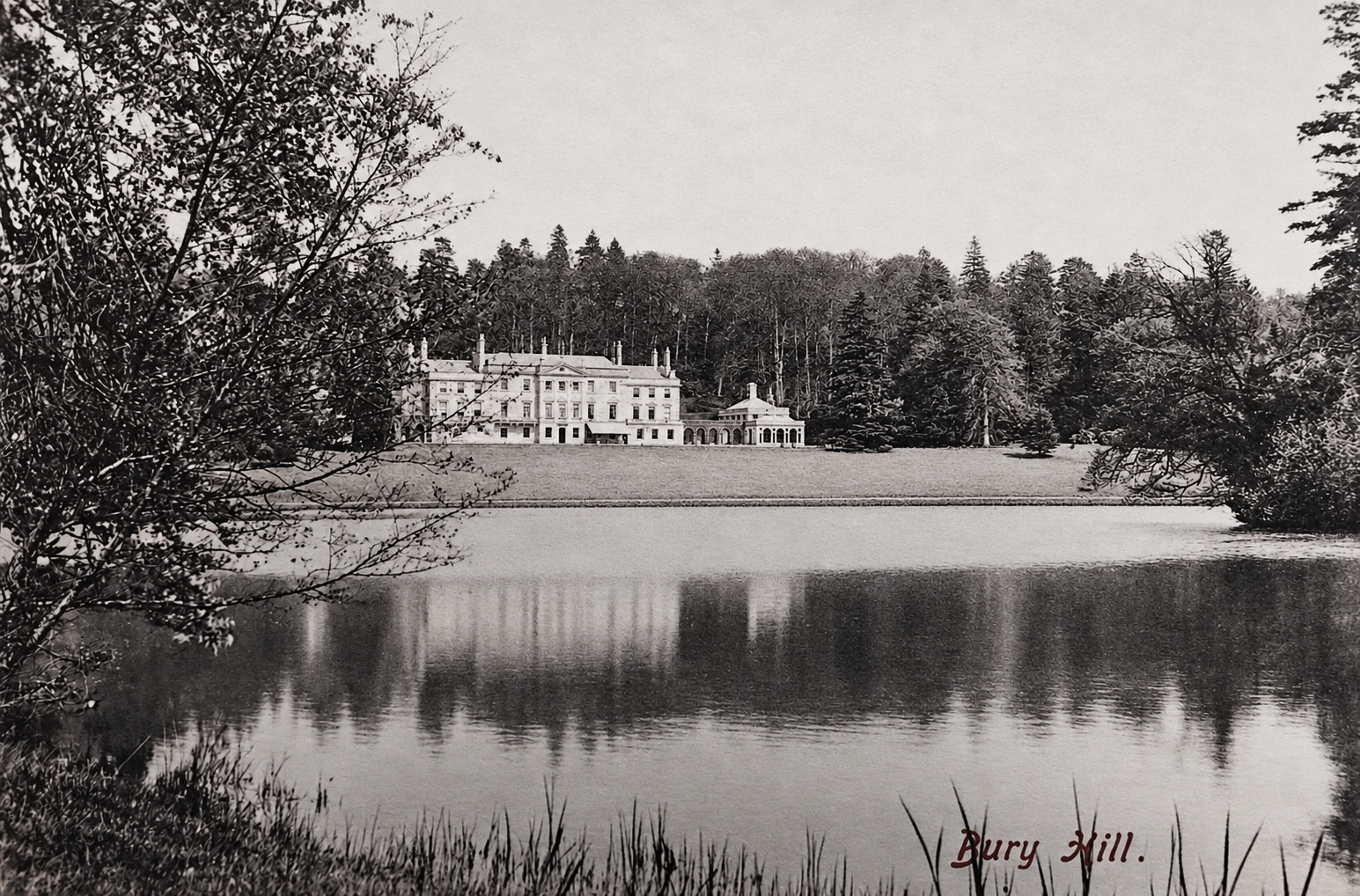
The schedule offered 30 classes for cottagers and 32 for “amateur cottage gardeners“, and the subscription list raised nearly £40. On Wednesday 24 July 1901 the Westcott Horticultural Society held its first annual show, in a marquee in the grounds of Bury Hill.
It rained heavily that morning, but the day cleared. About 200 entries were staged, the Dorking Town Band played, and there was dancing in the evening. The society’s President, Robert Barclay of Bury Hill, was too unwell to attend his own show, so Mrs Barclay gave out the prizes. The undoubted star was a cottager, R. Martingale, who won almost everything from the best garden to the new-laid eggs (and around one month’s wages in prize money). The vicar, mindful of the losers, hoped that next year some competitors “would not be allowed to have it all to themselves“. Honestly, we still have that problem today – but you need to be in it to win it!
Read the full newspaper report and prize list for 1901 here.
Cottagers, amateurs and the big houses
From the start, the shows mirrored the village itself. Competitors were divided into three tiers:
- Cottagers grew their own food and did their own digging. In 1913 the society defined a cottager, rather pointedly, as “one who employs no labour in his garden”. These could however include professional gardeners in their leisure time, away from the big houses.
- Amateurs gardened for pleasure: tradesmen, shopkeepers and the like.
- The open classes were where the gentry competed, with their head gardeners doing the work. The prize lists read “R. Barclay (G. Kew)” or “C.C. Druce (Neave)”, with the owner’s name first and the gardener’s name in brackets. Doesn’t seem fair really does it?
Nobody in 1901 seems to have realised it, but this was an old idea. The village’s first society, in 1857, had divided its entrants in much the same way: cottagers, a few amateurs, and a separate best-garden class for “mechanics and gentlemen’s labouring gardeners”, so that the men who gardened for a living didn’t sweep the board. What it didn’t have was an open class. In the 1850s and 60s the gentry paid for the prizes, gave wheelbarrows and digging forks, and lent their head gardeners as judges, but they never competed. At one show the amateurs even handed back their winnings to buy tools for the cottagers (read about the 1857 society).
The cottagers’ classes were always the busiest. In 1903 there were about ten entries in each, against three in the amateur classes. Even the vicar had a go, coming third with some honey.
The big houses also sent “groups”: banks of palms, ferns and flowering plants, staged by their head gardeners purely for display. The cottager could see what a garden with glasshouses and a staff could manage, and the visitors had something spectacular to look at. In 1901 the Bury Hill conservatories sent peaches, melons and grapes, and Mr Barclay’s group of plants took the centre of the tent.
The head gardeners judged the cottagers’ classes, sat on the committee and, in one case at least, seem to have come up through them. In 1903 a W. Graysmark was winning cottagers’ prizes for vegetables. By 1905 Mr Graysmark was head gardener at Bury Hill, with about fifteen gardeners under him, and half a century later he was remembered as one of the show’s great judges. He was still living in the head gardener’s house when the estate was sold in 1952. Many of the cottagers he competed against were his colleagues. Photographs of the Bury Hill garden staff from around 1905 and 1910 include Bignold, Best, Hopkins, Rose, Wakefield and Woods, all regular winners in the cottagers’ classes. Some of those families had been winning in Westcott for half a century. A Bignold was among the Bury Hill cottagers given garden prizes in 1856, and Roses, Wilkinses, Beadles and Razzells all appear on the prize lists of 1858–62.
Show by show
The show went to a different big house almost every year:
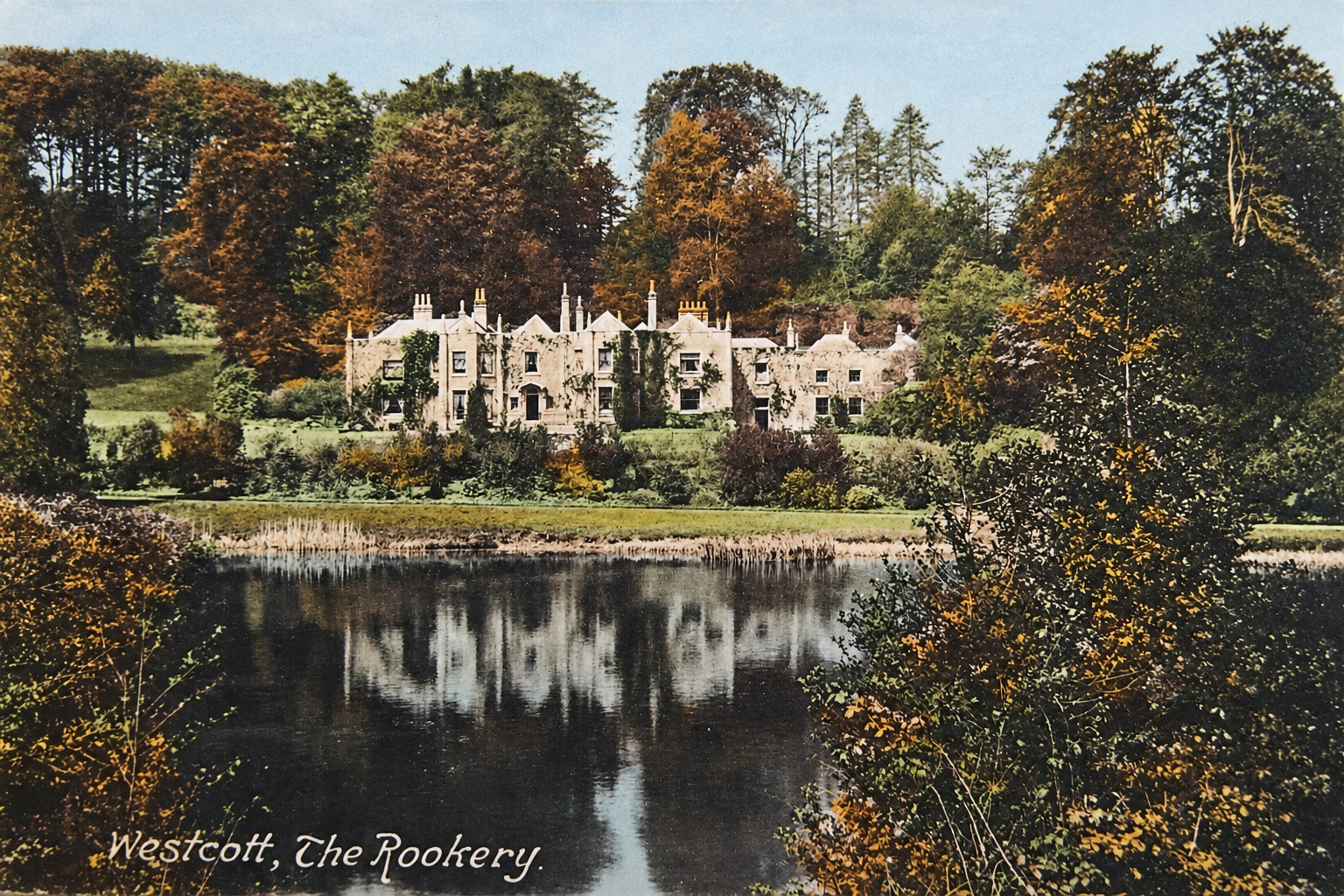
1903, the Rookery. For the third show, Mr L. Bulteel opened the Rookery grounds, and visitors were promised boating on the lake, visits to the waterfall and “a stroll through the lovely grounds”. There were over 400 exhibits, about a hundred more than the year before. The profits from the refreshment and needlework stalls went to the Westcott District Nurse Fund. Raising money for village causes was part of the show from the beginning.
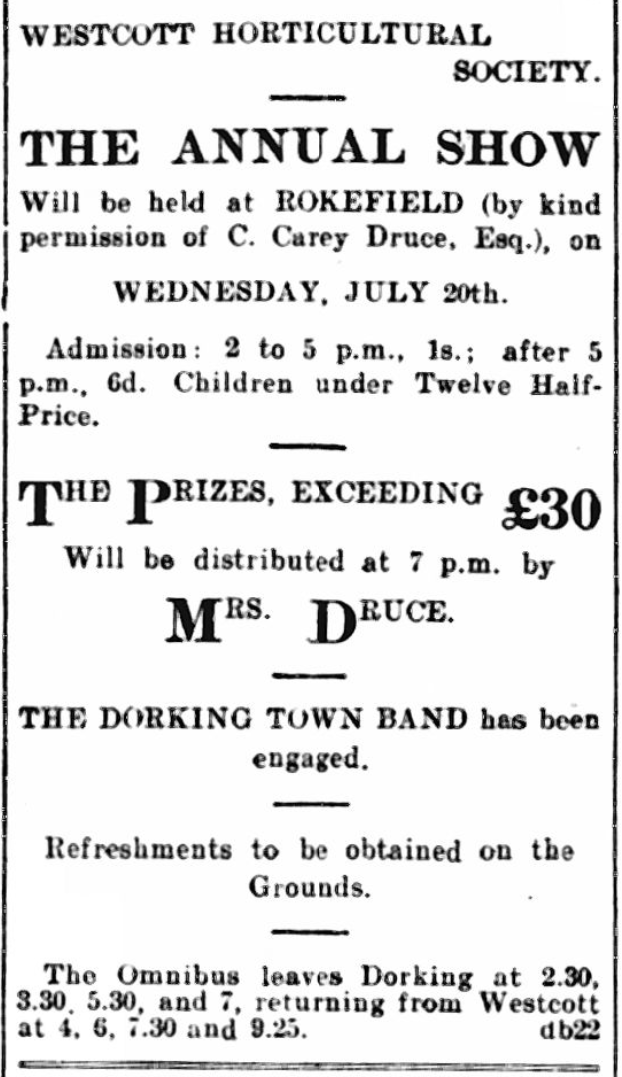
1904, Rokefield. C.C. Druce, one of the founding committee, lent his own grounds. The society’s advertisement promised “Prizes exceeding £30 in total”, to be given out at 7pm by Mrs Druce. Admission was a shilling until five o’clock and sixpence after, with children under twelve at half price.
1905, Milton Court. Mr and Mrs Rate’s show was “in every way a record success”, with record crowds and nearly £30 in prizes again. It also brought two firsts. One was prizes for cookery, open to “cottagers’ wives and daughters”. The best class was the “best workman’s dinner“, suggested by Miss Drew of the Rookery and won by a Mrs Rose, who had spent two years in the cookery class at the village Continuation School.
The other first was a Mr Newman of Guildford demonstrating the Minimax fire extinguisher, twice, on “a lighted pile of inflammable material”, to “interested and astonished assemblies”. Boating was permitted too (we can only hope the two attractions were kept well apart). Afterwards Mrs Rate gave tea to the estate hands, the committee, and the exhibitors’ wives and children, with a toy for every child.
1907, Brooklands. Our fullest report comes from this show. The cottagers competed in everything from long-pod beans to a bunch of herbs, and the best cottage garden scored 152 marks. The women’s “industrial section”, started in 1905, had over 80 entries, including a workman’s dinner, a roly-poly and a child’s washing frock. The boys competed with whole gardens. The star was W. Burrell, who scored 50 points but was denied the championship cup because he had won it before, so it went to the runner-up, W. Woods. The show was a week later than usual, which hurt the fruit, and the paper noted that the “plant groups” were “rather at a discount”: Milton Court, Milton Heath and the Rookery had sent none that year.
1910, Westcott House. By the tenth show the day had grown into a proper village fête. The gate was a record. The village lads gave a gymnastic display, “Ye Merrie Mummers” performed on the tennis court, the children put on a fairy play, and the dancing went on until after dark. Best of all, there was a skittles competition with a first prize of a pig.
1911, Rokefield. Back to the Druces, with the village Choral Society singing glees and part songs, “again”.
1912, Milton Court. Remembered fifty years later as one of the very best shows, and the paper agreed that the quality “far surpassed that of the previous year”. It was also a show where the rules applied to everyone. L.P. Roberts, the society’s own honorary secretary only two years before, staged some “very fine sweet peas”, ignored the conditions in the schedule, and was disqualified. Music came from the Dorking Town Band and a gramophone lent by Messrs T. Andrews and Co.
The dahlia show (forerunner of today’s Autumn Show)
Westcott also had an annual Dahlia Show of its own. It seems to have started in 1901, since the Dorking Advertiser announced “the 7th annual” show in August 1907, and it ran until at least 1911. In 1907 it was held on Wednesday 4 September in Brooklands Meadow, by permission of C. Sanger Esq. and Messrs Balchin and Sons. Mrs Carey-Druce gave out the prizes, the Dorking String Band played, and there was dancing from seven. In later years the show moved to the Paddock and to Rokefield.
Four names kept coming up among the dahlia winners: J. Johnson, W. Burrell, W. Martingale and F. Balchin. William Martingale is a good example of the men behind those names. For 46 years he was the gardener at Milton Court, and in his own time he grew prize-winning vegetables and dahlias. When he died in 1939, aged 65, one of the wreaths at his funeral was labelled simply “His own garden”.
What the 1913 schedule tells us
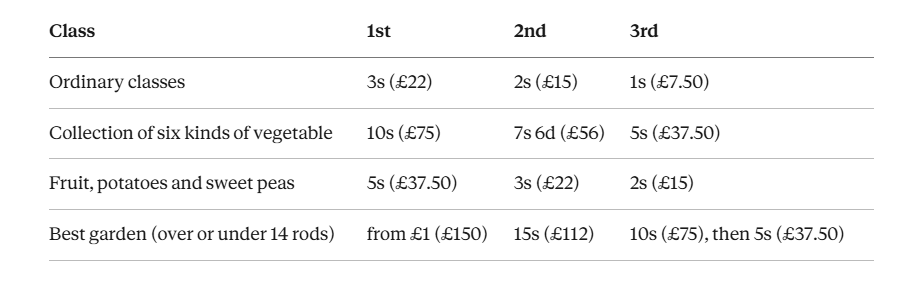
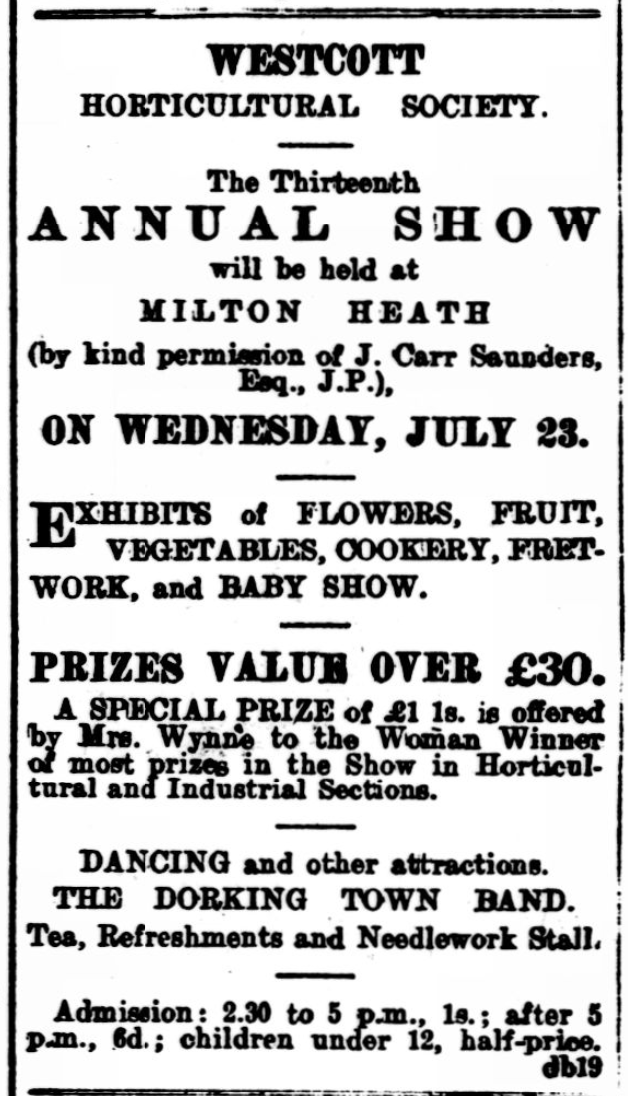
The 1913 show, at Milton Heath by permission of J. Carr Saunders, J.P., was advertised as “The Thirteenth Annual Show”: proof of an unbroken run since 1901. The advertisement promised “flowers, fruit, vegetables, cookery, fretwork, and baby show”, prizes worth over £30 (£4,500 in today’s money), dancing and the Dorking Town Band. Mrs Wynne offered a guinea (£150 today) to the woman who won the most prizes across the horticultural and industrial sections.
Extracts from that year’s schedule were copied into a club history written around 1962, and they give a good view of how the society worked. Membership was open to everyone living in the ecclesiastical district of Westcott. Members paid at least 2s 6d a year (about £19 today) and cottagers at least 1s (about £7.50). Miss the 15 July deadline and your membership lapsed, with a 3d fine (about £2) to get back in. Members could enter six classes free and paid a penny (about 60p) for each extra entry. Exhibitors were asked, where they could, to name the seed variety behind their vegetables (a habit every modern show secretary would quietly welcome back).
The prize money looked like this, with a rough modern equivalent in brackets: