



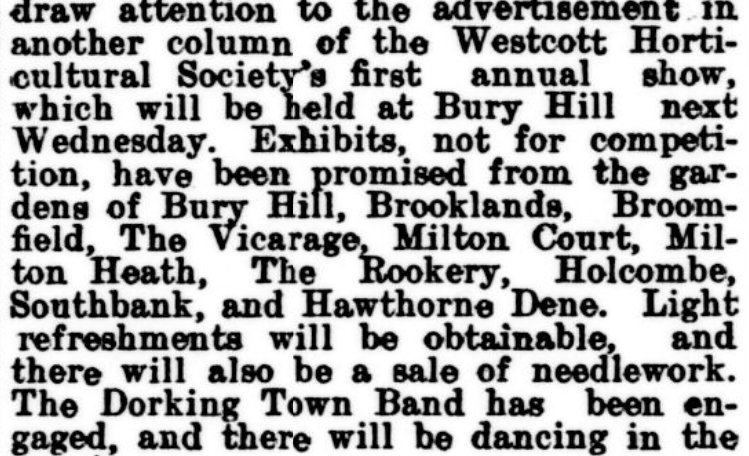
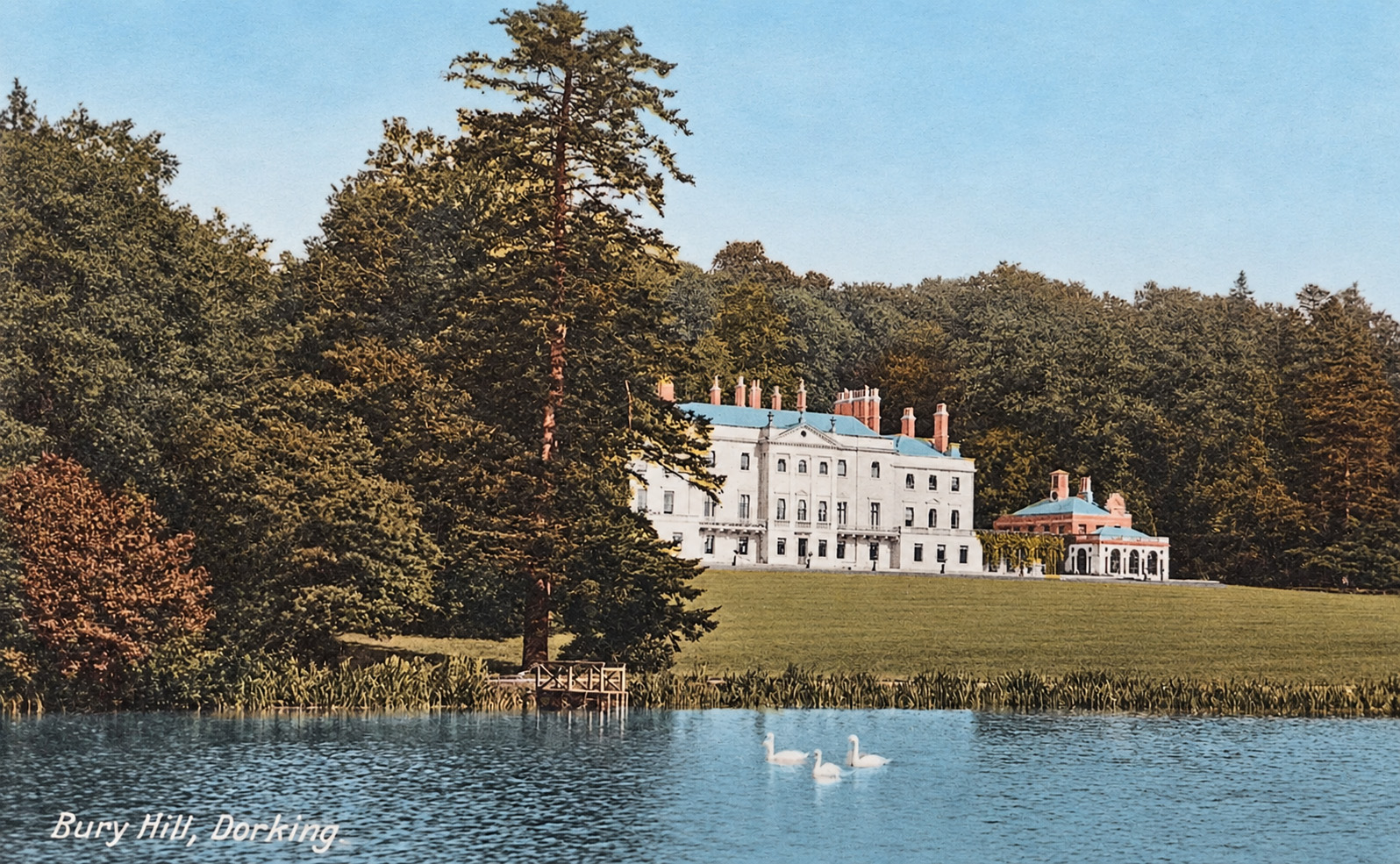
On Wednesday 24 July 1901, the newly formed Westcott Horticultural Society held its first show in a marquee in the grounds of Bury Hill. It had been just over a year since the vicar called a meeting at the Reading Room to ask whether the village wanted a flower show. The answer was clearly yes. (Nobody seems to have recalled that Westcott had already had a flower show society, from 1857 to 1862). The schedule offered 30 classes for cottagers and 32 for amateur cottage gardeners, subscriptions of nearly £40 had come in, and on the day about 200 entries were staged, most of them from the village’s cottage gardeners.
Three days later, on Saturday 27 July 1901, the Dorking Advertiser printed a full report of the day and the complete prize list. We reproduce it below as it was printed, with the original spelling.
Many of the names will be familiar to anyone who knows the village. Some of the families were still showing decades later. One of the hopes the vicar expressed that day, that “several of the competitors would not be allowed to have it all to themselves“, became a society rule by 1913: no exhibitor could take more than two first prizes. You can read the rest of the story via our history page.
Horticultural Show
Dorking Advertiser, Saturday 27 July 1901
The first exhibition of the newly-formed Westcott Horticultural Society was held in Mr. Barclay’s pleasant grounds at Bury Hill on Wednesday last, and the success which attended it must have been highly gratifying to all concerned. The exhibits were staged in a spacious marquee, and formed a very pleasing display. The entries numbered about 200, and what constituted a very satisfactory feature is the interest which the cottagers have displayed, and the healthy competition which has apparently arisen in their endeavouring to produce the best results. The past season has been anything but satisfactory, as only those who have tried to raise vegetables know, but the Westcott cottagers seemed to have been especially favoured by Nature, for many of the exhibits shown on Wednesday seemed to have been brought to as near perfection as they could well be.
The society has been particularly fortunate in securing the valuable patronage of the neighbouring gentry, who manifested their interest in this initial effort by sending most acceptable exhibits for non-competition. These added greatly to the attractiveness of the show, and tended largely to its success. The president (Mr. Barclay) was represented by a very fine collection of plants, ferns, and palms, which occupied the centre of the tent, the staging doing infinite credit to Mr. Kew. This collection obtained from the judges high commendation for quality and effect. Another attractive group was sent by Mr. Carr Saunders, of Milton Heath; the plants were of a varied character, and of excellent growth, the effect being heightened by a border of maidenhair fern, and a background of fine palms. This collection was also highly spoken of by the judges. The Dowager Marchioness of Hertford (gardener, Mr. Harding), contributed a smaller group, chiefly maidenhair fern, and other groups by Mr. Chalcraft, which were highly commended, were effectively staged on either side of the main entrance.
There was a magnificent show of fruit from the Bury Hill conservatories, including peaches (Barringtons), melons (Windsor Castle), and grapes (Black Hamburgs and Foster’s Seedling); Sir Thos. Paine sent finely grown tomatoes, currants, and other fruit, as well as several large pots of maidenhair fern. Messrs. Kent and Chalke, of Milton Farm, made a capital display with their honey, which was very highly commended for general excellence, and Mr. A. Heaver (gardener, Mr. Coleman), exhibited palms and bamboos. Mr. J. Walton, of Viewlands, was represented by a collection of British ferns, several of which are seldom seen in these parts; these received high commendation for good cultivation, as did also a very pleasing collection of herbaceous flowers contributed by Mr. J. M. Trower, of Southbank, and including well grown carnations, roses, sweet peas, perennial poppies, phlox, and sweet sultans. Mrs. Henry Jeater sent some excellent fuchsias, which were highly spoken of, and commended by the judges, and Mr. L. M. Rate (gardener, Mr. Geall), contributed a collection of magnificent carnations, their charming arrangement being deservedly commented on by the judges, and acknowledged with a high commendation. Another lovely exhibit from Milton Court, a vase of gypsophila and delpiniums [sic], was much admired for its attractiveness.
The Society is to be congratulated in securing so many excellent exhibits in the non-competitive departments, and its thanks are heartily due to those who thus gave it their support. The weather in the early morning was anything but promising, rain falling heavily, but, happily, it cleared up, and the afternoon and evening proved very enjoyable. The show was well patronised, the opportunity of walking through the lovely grounds proving an additional attraction to the visitors.
The judges, who carried out their onerous duties very satisfactorily, were: Mr. Wright (County Council), Mr. Moxham (gardener at Wotton House), and Mr. Geall (Milton Court), and for the gardeners Mr. Kew (Bury Hill), Mr. Neave (gardener to Mr. Druce), and Mr. Walton (to Sir Thos. Paine). Mrs. Barclay who, with her family, took the greatest interest in the exhibition, subsequently distributed the prizes in the absence of Mr. Barclay, who has not yet entirely recovered from his recent indisposition, though he was able to inspect the exhibits in the course of the afternoon.
Before the distribution the Vicar made a few remarks, in the course of which he expressed hope that they would have many more entries another year, and that several of the competitors would not be allowed to have it all to themselves, as had been the case on this occasion. He was glad to hear, on the authority of the judges, that it was an excellent show, and he hoped that even if they were not able to make it an annual event, they would make it a very frequent one. The Society owed many thanks to the gentry for the support they have given them, and while they were very sorry that Mr. Barclay was not able to be present, they were deeply grateful to him for the opportunity of holding their first show in his beautiful grounds, and to Mrs. Barclay for kindly consenting to distribute the prizes in his stead.
Mrs. Barclay then spoke a few happily chosen words, in which she said Mr. Barclay hoped the Society would hold its exhibition at Bury Hill another year. At the close of the distribution hearty thanks were accorded Mrs. Barclay for distributing the prizes, to Mr. Barclay for the use of the grounds, and to others for the loan of exhibits. The town Band provided excellent music, and dancing followed the distribution of prizes.
Thanks are especially due to Mr. E. W. Johnson, who has very efficiently carried out the hon. secretarial duties. He has been ably seconded by the following committee: The Rev. A. D. Woolley (hon. treasurer), Messrs. H. L. Bostock, Coleman, C. C. Druce, Grace, Harding, G. Kew, Robbins, Stedman, J. M. Trower, Wakeford, Walton, and Wright. Besides having Mr. Barclay as its president, the Society has the good fortune to possess among its patrons: The Dowager Marchioness of Hertford, the Lady Florence Blunt, Miss Money, Mrs. Spicer, Sir Thos. Paine, Mr. L. Bulteel, Mr. A. Heaver, Mr. J. Carr-Saunders, and Mr. W. W. Wynn.
Prize List
Cottagers
- Collection of vegetables: 1 J. Young, 2 R. Martingale, 3 W. Burrell.
- Runner beans: 1 Mrs. Worsfold, 2 J. Young, 3 F. Balchin.
- Dwarf beans: 1 J. Young, 2 G. Grantham, 3 R. Martingale.
- Broad beans: 1 G. Grantham, 2 W. Capon, 3 W. Burrell.
- Beet: 1 R. Martingale, 2 W. Burrell, 3 G. Grantham.
- Cabbage: 1 W. Wilkins, 2 A. Gibbs, 3 R. Martingale.
- Carrots, long: 1 R. Martingale, 2 W. Burrell, 3 J. Young.
- Carrots, short: 1 R. Martingale, 2 Mrs. Worsfold, 3 W. Wilkins.
- Lettuce: 1 F. Skilton, 2 R. Martingale, 3 G. Grantham.
- Lettuce, cabbage: 2 W. Burrell, 3 J. Young.
- Spring onions: 1 R. Martingale, 2 J. Young, 3 W. Burrell.
- Winter onions: 1 G. Grantham, 2 J. Young, 3 W. Burrell.
- Peas: 1 J. Young, 2 A. Gibbs, 3 Mrs. G. Brown.
- Potatoes, white kidney: 1 R. Martingale, 2 F. G. Balchin, 3 Mrs. Worsfold.
- Potatoes, round: 1 G. Grantham, 2 R. Martingale, 3 F. Brooker.
- Collection of potatoes: 1 R. Martingale, 2 J. Young, 3 Mrs. Worsfold.
- Turnips: 3 R. Martingale.
- Tomatoes: 1 R. Martingale, 3 W. Wilkins.
- Marrow, white: 1 R. Martingale, 2 W. Wilkins, 3 J. Young.
- Marrows, green: 1 C. Miles, 2 J. Young.
- Raspberries: 1 Capon, 2 Gibbs.
- Currants, white: 2 F. G. Balchin, 3 A. Gibbs.
- Currants, black: 1 Capon, 2 Mrs. G. Brown, 3 A. Gibbs.
- Gooseberries: 1 Upson, 2 Skilton, 3 R. Martingale.
- Best garden: 1 R. Martingale, 2 Burrell, 3 Maskell.
- Dahlias: 1 F. G. Balchin, 2 G. Grantham.
- Sweet peas: 1 R. Martingale, 2 Capon, 3 Burrell.
Amateurs
- Collection of vegetables: 2 J. Jennings.
- Dwarf beans: 3 J. Wakefield.
- Broad beans: 3 F. Rhodes.
- Beet: 2 J. Johnson.
- Cabbage: 2 W. Hopkins.
- Carrots, short: 2 J. Johnson.
- Lettuce: 3 W. Hopkins.
- Peas: 1 W. Hopkins, 2 J. Wakefield.
- Raspberries: 1 Miss Wood, 2 J. Wakefield.
- Currants, white: 1 W. Hopkins, 2 J. Wakefield.
- Currants, red: 1 Mrs. A. Rose, 2 W. Hopkins, 3 J. Wakefield.
- Currants, black: 1 J. Wakefield, 2 W. Hopkins.
- Gooseberries: 1 J. Johnson, 2 J. Wakefield, 3 F. Rhoades.
- Cucumber: 3 F. Rhoades.
- Dahlias: 2 J. Johnson.
- Fuchsias: 1 J. Wakefield, 2 F. Rhoades.
- Mixed plants: 2 F. Rhoades.
- Best gardens: 1 J. Wakefield and W. Hopkins equal.
Children
- Collection of wild flowers (named): 1 A. Johns, 2 E. Hamlyn, 3 A. Johnson.
- Specials: B. Capon, H. Dixon, G. Brown, E. Rhoades, L. Hamlyn, A. Huggett, and Brooker.
Open Classes
- New laid eggs: 1 R. Martingale, 2 J. Jennings, 3 A. Ryde.
- Honey (3lb. sections): 1 F. Rhoades, 2 Mr. Chalke, 3 the Rev. A. D. Woolley. Special: T. Upson.
- Run honey: 1 Mr. Chalke, 2 T. Upson, 3 Mr. G. Bowen.
- Lady’s spray and gentleman’s buttonhole: 1 Edith Johnson, 2 Mrs. Rose.
Special Prizes
Presented by Messrs. Toogood and Sons, Southampton. Exhibitor winning the greatest number of prizes: 1 (silver medal and certificate) R. Martingale, 2 (bronze medal and certificate) J. Young, 3 (certificate) J. Wakefield.
Best school garden: equal 1 Truelove and Brown, equal 2 Jeater and Elinson.
Who won?
The undoubted star of the day was R. Martingale, a cottager, who took the silver medal for the most prizes. He won the best garden, the collection of potatoes, long and short carrots, white marrows, tomatoes and sweet peas, among others, and even the new-laid eggs. Martingales were still among the leading names at the show six years later. J. Young came second overall, and J. Wakefield third.
It may be Martingale the vicar had in mind when he hoped that next year some competitors “would not be allowed to have it all to themselves“. At this first show he likely collected around £3 in prize money, the best part of a month’s wages!
Two other things stand out. The new society’s president, Robert Barclay of Bury Hill, was too unwell to attend his own show, so Mrs Barclay presented the prizes. And the vicar, Rev A.D. Woolley, who had called the meeting that started it all, not only served as treasurer but also entered his own honey, coming third.
Source: Dorking Advertiser, 27 July 1901. Spelling and punctuation as printed. “F. Rhodes” and “F. Rhoades” both appear in the original; they are very probably the same man.